Strategy Analysis
Strategy Analysis refers to a significant shift in the underlying methodology compared to a Multi-Constraint Analysis. The most noticeable difference relates to how the analysis procedure solves the optimization problem across years. In a Multi-Constraint Analysis, the problem is solved discrete in time. This means that the network condition is computed for every single year and treatments are recommended based on the current year’s condition data. The solutions calculated thereof is carried forward to the following year to update the network-level PI and the process is reiterated. With strategy analysis, the network optimization is solved once for the entire analysis period with the objective of determining the optimal solution across the entire planning horizon.
One of the distinguishing features of a strategy analysis is the setup of strategies. A strategy can be defined as a collective treatment plan for a given section over the entire analysis period. As part of the strategy setup, a user would typically specify when he/she anticipates funding to be available with the highway agency to fund any M&R activity for the specific section. Following this step, the system lets the user compute section strategies which involve determination of a possible mix of treatment types over the analysis period, given the available funding sources and the existing network condition. It is important to note that out of all the available treatment strategies, one must include a “No Funding Available” scenario (i.e., Do Nothing) for each of the individual years in the analysis period. This way the user can let the optimization engine determine whether a particular section is in need of any M&R activity at all. The absence of this provision would otherwise force the optimization engine to select a maintenance treatment even when it is not needed. It is also recommended that the user should at least create a few different treatment strategies such that the optimization routine has a sufficient number of feasible solutions for a given section. One should also take into consideration the computation time necessary in the event of an enormously large solution space. Take the example of a user who is working with a network containing tens of thousands of pavement sections and is interested in developing a work plan over a 10-year analysis period. If it is assumed that the user intends to develop strategies for individual sections that are mutually exclusive and exhaustive; the total number of strategies per section would be 210 or 1024 which multiplied by the number of sections leads to more than ten million possible solutions. A problem of this magnitude would require extensive computational effort. It is recommended that engineering judgment should be exercised in developing the treatment strategies to keep the problem manageable.
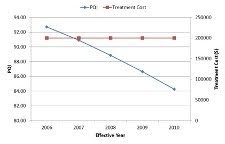
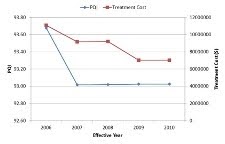
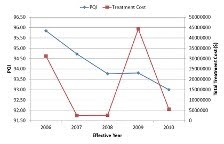
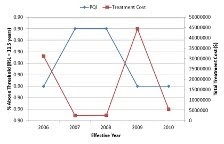
Once the treatment strategies are developed, the subsequent steps are similar to that of Multi-Constraint Analysis wherein the user will need to specify the objective function and the constraints pertinent to the problem. At analysis completion, the proposed work plan will select one of the available strategies for every single section that maximizes/minimizes the objective function subject to the constraints specified. The collection of graphs below demonstrates the results for the same scenarios that were earlier executed for ranking using a strategy approach.
|
| Strategy Analysis – Maximize PQI s.t. Fixed Budget + Minimize Cost .t. PQI = 93 |
|
| Strategy Analysis – Minimize Treatment Cost s.t. PQI = 93 & % Network with RSL >= 11.5 years > 90 |
In short, in Strategy Analysis, for every road section the user will supply several treatment strategies as input. The present value cost and multi-year benefit/condition calculations for each road section and strategy is then used as the input into the integer programming optimization engine. The result is selection of the best life cycle strategy per road section.
The shared components between Treatment and strategy analyses are as follows:
- Use of decision trees (for strategy analyses, it is included in the strategy input phase rather than during analysis). Also, while INCBEN decision trees may be used in strategy analyses, only the first recommended treatment of each decision tree limb will be used and the other two treatment options will be ignored.
- Use of deterioration (but, for strategy analyses, in the strategy input phase rather than during analysis).
- Integer programming engine.
- The same options for objective function and constraints (but, in strategy analyses, applied to the entire rehabilitation life cycle rather a specific rehabilitation recommended for a section in a given year).
The difference between strategy analysis method and Multi-Constraint Analysis include:
- Strategy analysis method optimizes over the entire analysis period rather than a year at a time.
- In order to do that, the input into the integer programming engine is present value costs and multi-year benefit/condition formulations derived from multi-year rehabilitation strategies. These inputs must be pre-calculated.