Multi-Constraint
The Multi-Constraint Analysis refers to the most generic problem within the class of optimization problems that are solved discrete in time as part of the network optimization tool in the PMS module. As the title suggests, the problem can be specified to handle multiple constraints. Highway agencies are often faced with the challenge of meeting multiple targets, like maintaining a targeted average PI across the network with no more than a specific number of lane-miles below a certain PI. The aforementioned problem can be formulated with two separate constraints that limit the targeted PI and the percent of the network that must be above the specified threshold. The network optimization feature lets the user specify constraints in one of three different ways:
-
The total must not exceed specified targets; mostly used to specify treatment costs.
-
The weighted average should be greater/lesser than certain thresholds; used for specifying the targeted PI/RSL/Benefits across the network. The weighted average is calculated based on the analysis weight groovy or the SQL expression (discussed later).
-
The percent above threshold specifies the minimum percentage of the network that must meet the targeted PI.
Thus, for the example provided earlier, one would select two constraints, one each of the second and the third type to ensure that the PI across the network meets the specified level with no more than a certain fraction below the minimum acceptable PI. Objective functions are specified the same way as constraints, except that they aren’t assigned any constraint value. Furthermore, the decision to maximize/minimize the objective function is determined by the selection made in the “Objective Direction” in the “Setup PMS Columns” screen. In the event where the “Objective Direction” is not explicitly set by the user, the system seeks to minimize columns that relate to costs and maximize everything else.
Each of the four aforementioned analysis procedures can be solved discrete in time. This means that should a user decide to run the analysis across multiple years, the system would solve the problem once for every single year wherein the solution from the previous year will be brought forward to the current year to determine the network condition. Highway agencies are often faced with budget fluctuations across years and therefore need to plan a priori. The “Propagate Years” feature lets the user set individual constraints for every year included in the analysis period separately, thus adding more flexibility to the analysis procedure. It is important to note that the underlying analysis mechanism hardly changes due to incorporation of this feature as the problem would still be the same with the same set of constraints but different constraint limits for the individual years.
On certain occasions, highway agencies might consider higher PI for arterials and expressways to be considered acceptable compared to local and residential streets due to the obvious reason that these facilities cater to higher traffic volumes. On other occasions, the agency might want to allocate a fixed percentage of its annual maintenance budget for preventive maintenance (PM), rehabilitation and full-depth repair work. In order to tackle these scenarios, the AgileAssets PMS module offers the “Activate Constraint Subdivisions” feature which lets the user enforce additional constraints within a certain genre of constraint. The examples included earlier refer to some of the typical scenarios wherein the user might want to refer to this feature.
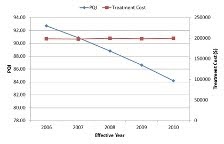
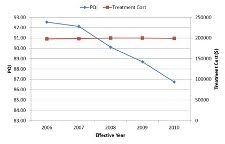
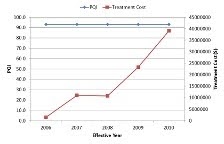
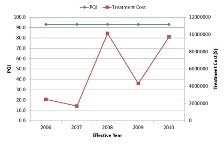
The collection of graphs below demonstrates the results for the same scenarios that were earlier executed for ranking using a multi-constraint approach. An optimization problem involving a single constraint is similar to “Ranking” (benefit-cost ratio) and therefore the results illustrated in the collections of graphs above and below resemble each other closely.
|
|
| Multi Constraint – Maximize PQI s.t. Fixed Treatment Cost (w/o WP) | Multi Constraint – Maximize PQI s.t. Fixed Treatment Cost (w/WP) |
|
|
| Multi Constraint – Minimize Treatment Cost s.t. Fixed PQI (w/o WP) | Multi Constraint – Maximize PQI s.t. Fixed PQI (w/WP) |
The scenario discussed in the collection of graphs below includes an additional constraint to the aforementioned problem by requiring that 90% of the network has a RSL of 11.5 years. It is understood that the additional constraint will result in higher treatment cost as it has to satisfy additional demands placed on the system. To visualize, the additional constraint adds a new lower bound to the problem which restricts the solution space to fewer choices than that available previously.
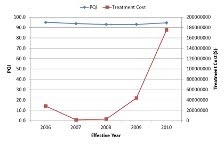
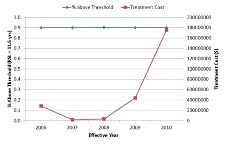
|
| Multi-Constraint Analysis – Minimize Cost s.t. PQI >= 93 & % network with RSL = 11.5 yrs >= 90 (w/o WP) |
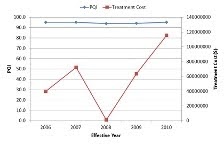
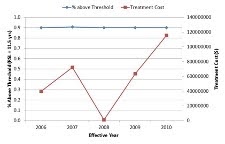
|
| Multi-Constraint Analysis – Minimize Cost s.t. PQI >= 93 & % network with RSL = 11.5 yrs >= 90 (w/WP) |
In multi-constraint optimization analysis, the initial characteristics for all road sections come from the Network Master table. It then uses an integer programming optimization engine to simulate future years. For each year in the analysis period, the following sequence of steps occurs:
- Before the optimization analysis is run, all road sections have their conditions deteriorated by a year.
- Use the decision trees to assign possible treatments.
- The optimization engine is then applied independently of each year of the analysis period.
- At the end of the year, after optimization is run, the road sections that have been rehabilitated have their conditions improved accordingly.