Case Violations
You can view, edit, and create case violations in the app.
Code violations are used to identify conditions that do not meet a set of rules or code requirements.
The default query for case violations automatically displays violations (most recent results appearing first) that meet the following criteria:
- Assigned to Current User
- Not in a Completed, Closed, Canceled, or Inactive State
 View Case Violations in the Work Activity List
The work activity list displays all of the work activities in your selected work activity type.
- Tap the work activity type drop-down on the Top Navigation menu.
The View panel opens, displaying each activity type along with the number of work activities in each work activity list. The displayed count indicates how many activities of that type are assigned to you. For example, Assigned to me (7) above Service Requests indicates that there are seven service requests assigned to you.
- Tap Case Violations.
The work activity list updates.
Create a Case Violation
You can create a case violation and add it to an existing case using the Add icon on the map.
- Open the Map.
- Tap the Add icon.
The Add panel opens.
- Tap Case Violations.
- Select a case to add to the case violation.
- Select a Violation Type.
- The Create Violation panel appears.
- Enter information into the desired fields for the case violation.
- Tap Save.
The case violation is created and appears on the map and in your activity list.
Edit a Case Violation
You can edit an existing case violation.
- Tap a case violation.
- Edit the work activity details. See View Work Activity Details for more information.
- Tap Save.
The case violation is updated.
View the Related Parent Case
You can view the parent case that is related to the case violation.
- Open a case violation.
- Tap Related Case.
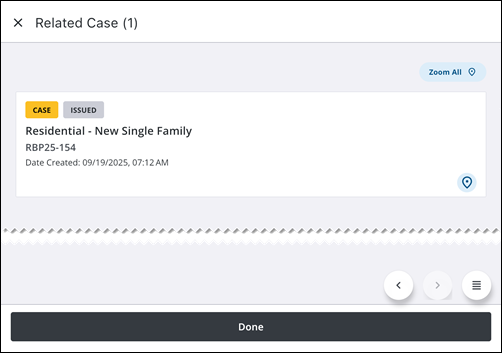
The Related Case page opens, showing the following details:
- Zoom All: Tap to zoom to the parent case on the map.
- Map icon: Tap to view the parent case on the map.
- To view the parent case, tap on the summary card.
The parent case opens.