Strategy Analysis with Work Plan
The strategy analysis discussed in Strategy Analysis refers to analysis scenarios that aim to propose a work plan without taking into consideration any other existing work plans. Highway agencies often encounter scenarios where certain projects are shortlisted outside of the purview of the pavement management program. For example, the state department might allocate dedicated funds for improvement of safety standards across the network which might lead to selection of projects that have a history of high accident rates. In other scenarios, certain projects might be included as a result of political intervention or public opinion. For such instances, it would be meaningless to run an analysis that overlooks changes in the network resulting from the existing work plan. The strategy with work plan analysis overcomes this limitation and lets the user include projects from the existing work program. The Strategy with Work Plan analysis is similar to the Strategy analysis. The difference is that the Strategy with Work Plan can include the treatments defined in the master work plan. In Strategy Analysis, even if a MWP is included in the scenario settings, the system will not use it during the analysis. The result of the Strategy with Work Plan type of analysis is the projects and treatments that satisfy the constraints of the analysis.
In the case of strategy analysis, the strategies are computed prior to execution of the optimization routine. The user selects the strategies that he/she wants to associate with a given section and lets the system compute the mix of treatments and the PI for every year included in the analysis period. Thus the optimization routine is not tasked with computation of the network condition at runtime as the PI-s are precalculated. It should be remembered that should a user decide to alter the decision trees or the groovy scripts affecting the RSL calculation or any other instrument that affects the decision variables, the calculated strategies do not apply anymore as they solely relate to the instance that existed prior to the changes made. So one would need to rebuild and re-calculate the strategies anytime changes are made that affect the decision variables. However, in the case of strategy with work plan, the PI across the network is calculated at runtime as the system needs to update the network condition prior to selection of the treatment strategies for a given section. Therefore, running a “strategy with work plan” scenario without selecting a work plan will be equivalent to the “strategy” scenario except that the strategies will be calculated at run time in the first case but pre-calculated for the latter. It is important to realize that the “strategy with work plan” ensures that the analysis is based on the latest instance of the decision variables and all other instruments that govern them. The fact that the “strategy with work plan” requires computation of PIs, RSL and all other relevant decision variables at run time makes it necessary to design the problem carefully as large networks with hundreds of thousands of sections with an extensive selection of treatment strategies can take several hours of computation time. It is therefore advised that the user should carefully limit the analysis scope to the segment of the network that he/she is interested in determining the maintenance needs. Furthermore, the strategy with work plan offers additional features that allow the user to restrict the scope of the work plan according to his/her needs.
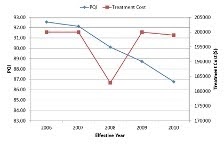
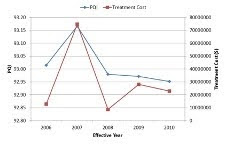
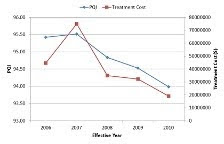
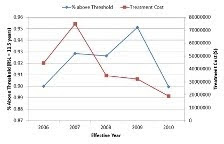
The graphs below demonstrate the results for the same scenarios that were earlier executed for ranking using a Treatment approach.
|
|
| Strategy w/WP – Maximize PQI s.t. Fixed Budget | Strategy w/WP – Minimize Cost s.t. PQI ≥ 93 |
|
|
| Strategy w/WP – Minimize Cost s.t. PQI ≥ 93 & % of network with RSL ≥ 11.5 years ≥ 90 | |